The 2026 Ultimate Guide to Automated Case Packing for Pouch and Bottle Lines
Introduction: The Current Bottlenecks of Manual Secondary Packaging in 2026
As manufacturing facilities push primary packaging speeds to their mechanical limits, secondary packaging—specifically case packing—has emerged as the critical bottleneck. In 2026, relying on manual labor for end-of-line operations exposes factories to a myriad of compounding inefficiencies. Understanding these modern bottlenecks is the first step toward justifying an automated upgrade with solutions like those offered by CasePackerPro.
First, the relentless acceleration of primary packaging machines (fillers, cappers, and form-fill-seal equipment) has far outpaced human dexterity. A modern high-speed pouch line can easily output 150 to 200 pouches per minute. Manual packing stations simply cannot sustain this throughput without deploying massive, cost-prohibitive labor forces across multiple shifts. This speed mismatch leads to micro-stoppages upstream, effectively crippling the Overall Equipment Effectiveness (OEE) of the entire line.
Second, ergonomic and safety liabilities are at an all-time high. Repetitive strain injuries (RSIs) resulting from the continuous lifting, twisting, and packing of heavy corrugated cases result in significant workers' compensation claims and elevated insurance premiums. The physical toll leads to high turnover rates, forcing plant managers into a perpetual cycle of hiring, training, and replacing floor staff—a hidden cost that severely dilutes profit margins.
Finally, manual packing introduces critical inconsistencies in pack patterns. Human fatigue inevitably leads to misplaced bottles or folded pouches, which compromises the structural integrity of the final corrugated case. When these flawed cases are palletized, the resulting pallet instability causes catastrophic load failures during transit. Automation eliminates these variables, ensuring mathematical precision in every case.
Pouch vs. Bottle Case Packing: Navigating the Mechanical Differences
While the goal of case packing is universal, the mechanical execution varies drastically depending on the primary container. Bottles and pouches exhibit fundamentally different physical behaviors, demanding specialized End-of-Arm Tooling (EOAT) and kinetic profiles. Understanding these distinctions is critical for procurement directors evaluating multi-format packing systems.
Bottle Case Packing: Rigidity and Grid Pick-and-Place Systems
Bottles—whether glass, PET, or HDPE—are inherently rigid, uniform, and stable. This rigidity allows for high-speed collation and precise spatial mapping. Automated bottle case packers primarily rely on Grid Pick-and-Place systems and drop-packing technologies.
- Lane Dividers and Collation: Bottles enter the packing zone via single-file conveyors and are actively diverted into multiple lanes using servo-driven oscillating guides. This creates a pre-determined matrix (e.g., a 3x4 or 4x6 grid) that matches the corrugated case dimensions.
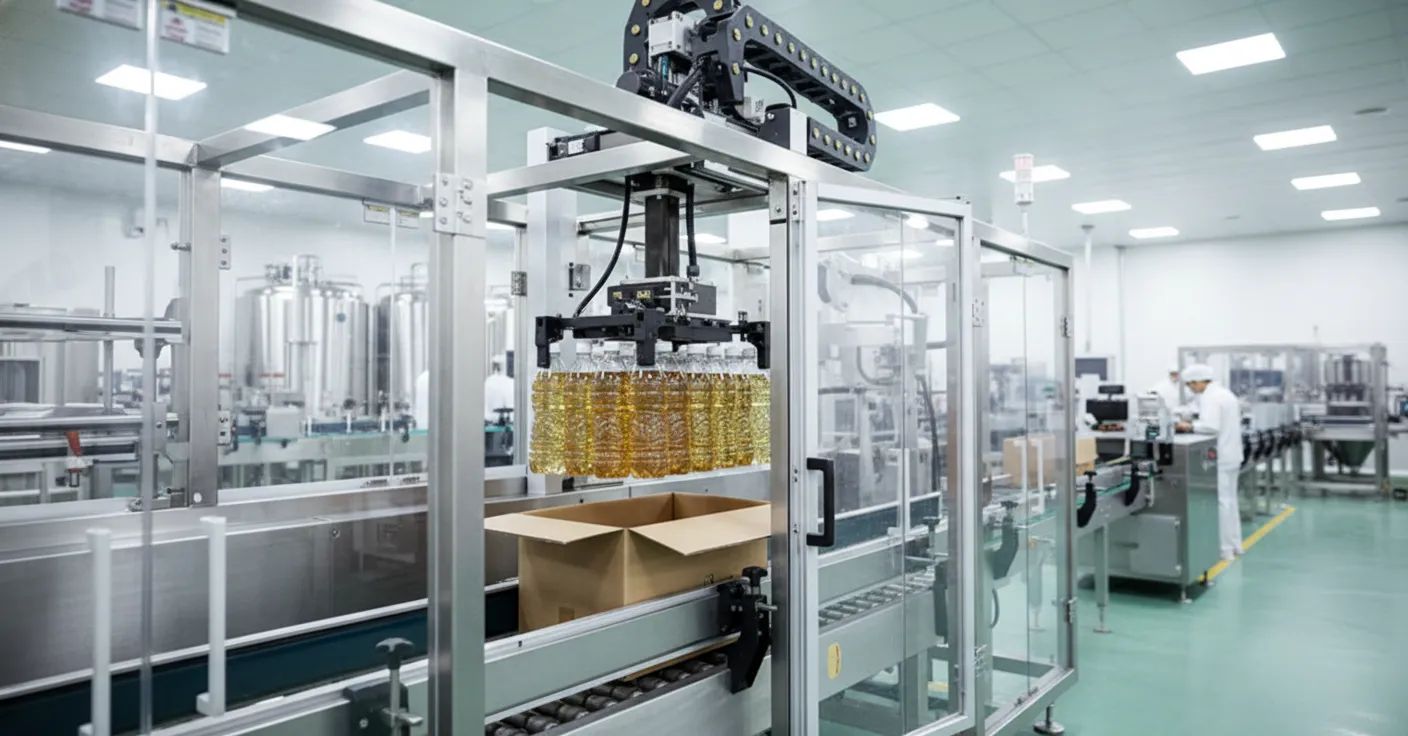
- Gripper Head Technology: The heart of a bottle packer is its tooling. For rigid neck bottles, pneumatic bladder grippers or mechanical pin-style grippers descend and lock onto the necks of the entire grid simultaneously. For non-tapered or delicate containers, vacuum cups mapped to the bottle caps provide a secure, non-marring hold.
- Kinetic Profiling: Once gripped, a multi-axis gantry or robotic arm lifts the matrix, translates it over the erected case, and descends. Advanced systems use a 'soft-placement' profile, meaning the downward velocity decelerates sharply just before the bottles touch the bottom of the case.
Pouch Case Packing: Flexibility and Vertical vs. Horizontal Loading
Pouches (stand-up doypacks, pillow bags, or quad-seal bags) are notoriously difficult to automate. They are flexible, contain varying amounts of headspace (air), and their center of mass shifts constantly. Pouches cannot be easily gripped by their necks or stacked like bricks; they require specialized handling.
- Settling and Conditioning: Before packing, pouches must pass over settling conveyors—vibratory belts that distribute the liquid or granular product evenly within the pouch, flattening its profile to ensure consistent dimensions for packing.
- Vertical Loading (Gravity Drop & Bomb-Bay Doors): For high-speed lines where pouches lay flat in the case, systems utilize high-speed indexing belts that shoot pouches into a staging cassette. Once a complete layer is formed, twin 'bomb-bay' doors snap open, allowing the layer to drop directly into the case below.
- Horizontal Loading (Side-Load Cartoning): When retail ready packaging (RRP) dictates that pouches must stand upright on the shelf, side-load systems are deployed. Pouches are collated vertically. A servo-driven mechanical pusher then extends, sliding the entire row of upright pouches horizontally through the open side flaps of a corrugated case.
Key Technical Specifications to Look For
When drafting an RFP (Request for Proposal) for an automated case packer, factory managers must look past basic marketing claims. The difference between a world-class automation cell and a maintenance nightmare lies in four critical technical specifications.
1. Speed and Throughput Capabilities
Evaluate speed not just by 'Cases Per Minute' (CPM), but by Surge Capacity. A machine rated for 20 CPM must comfortably handle surges of 25 CPM to clear upstream accumulation buffers. At CasePackerPro, we engineer our systems to handle these asynchronous surges seamlessly.
2. Footprint and Layout Optimization
Floor space is a premium asset. Legacy case packers were massive, linear behemoths. In 2026, procurement directors must demand compact, monoblock designs. Look for integrated systems that combine case erecting, loading, and sealing within a single robust frame, offering 360-degree access to minimize mean time to repair (MTTR).
3. Changeover Time (Toolless Changeover and SMED)
In high-mix, low-volume manufacturing environments, a machine that takes two hours to transition from a 500ml bottle to a 1L bottle is financially unviable. Demand Single-Minute Exchange of Die (SMED) compliance. Modern case packers must feature 100% Toolless Changeovers, including color-coded parts and recipe-driven servo adjustments via the HMI.
4. PLC Integrations and Smart Manufacturing
A mechanical masterpiece is useless without superior intelligence. The machine's Programmable Logic Controller (PLC) must natively integrate into your plant's existing architecture (e.g., Rockwell Automation/Allen-Bradley or Siemens). Mandate OMAC PackML compliance and IIoT capabilities for real-time predictive maintenance.
Troubleshooting & ROI: Ensuring Reliability and Financial Viability
Knowing how to solve physics-based challenges on the production floor, and how to definitively prove the system's financial worth, separates average managers from industry leaders.
Solving 'Product Damage' During High-Speed Drops
One of the most common issues in high-speed drop packing is product damage. This usually stems from uncontrolled kinetics.
The Solution: Implement Active Motion Profiling. Instead of a linear drop, the PLC should be programmed with an S-curve acceleration/deceleration profile. This ensures the tooling accelerates smoothly and dynamically brakes millimeters before release. If packing pouches, switch to high-flow, low-vacuum silicone suction cups.
The Ultimate ROI Calculation Formula for Case Packing
Securing CapEx approval requires a watertight Return on Investment (ROI) justification. A realistic ROI calculation must capture both 'Hard Savings' and 'Soft Savings'.
Step 1: Calculate Annual Labor Savings (ALS)
Example: 2 operators × 3 shifts × $60,000/year = $360,000 ALS.
Step 2: Calculate Material & Waste Savings (MWS)
Automated machines use exact amounts of tape/glue and eliminate dropped products.
Example: $25,000 MWS.
Step 3: Calculate Throughput Revenue Gain (TRG)
Automation typically boosts OEE by 5% to 15%.
Example: 500 extra cases/week × 50 weeks × $5 profit = $125,000 TRG.
Step 4: Factor in Soft Savings (SS)
Estimate the reduction in ergonomic injury claims and hiring costs.
Example: $40,000 SS.
The Formula:
Total Annual Benefit = $360,000 + $25,000 + $125,000 + $40,000 = $550,000.
Payback Period: If a CasePackerPro automated system costs $800,000: $800,000 / $550,000 = 1.45 Years.
Conclusion: Future-Proofing Your End-of-Line Operations
Transitioning to automated case packing is a strategic imperative that reaches far beyond simple labor reduction. By deeply understanding the mechanical nuances between pouch and bottle handling, demanding stringent technical specifications, and clearly articulating a comprehensive ROI, factory managers can drive unparalleled operational excellence. At CasePackerPro, we build intelligent, automated end-of-line systems that don't just pack cases—they protect your brand and secure your facility's competitive dominance in a rapidly evolving global market.